The Strategy vs. Execution Trap
Leadership Learnings with Kim

When I ask senior leaders to estimate what percentage of their time they spend solving problems versus creating the conditions for others to solve them, the average answer is 70/30. Seventy percent solving. Thirty percent building.
Most of them pause when they say it out loud (I literally ran this exercise with my team this morning).
Here’s the uncomfortable part: that ratio doesn’t feel wrong when you’re in it. It feels like leadership, and it feels like you’re doing something important.
We get promoted because we’re the best executors. The system rewards us for having the answer, for moving fast, for being the person everyone can count on. Then as a leader the system needs something different from you. And most of the time, nobody tells you clearly how to make that pivot.
Execution feels productive and gets you immediate gold stars. Strategy feels vague and uncomfortable, and the payoff is sometimes a longer game. So we all naturally (myself included) default to what’s measurable, what we’re great at, and what feels safe.
Here’s how you know you’re trapped executing, and avoiding strategy: You’re the bottleneck.
Decisions wait for you. Your team can’t move without you. You feel indispensable, and you’ve started to confuse that feeling with impact. What I’ve learned is that the indispensability isn’t a good thing - it’s a warning sign (and it will also definitely lead to burnout).
I watched this play out with a leader I was coaching.
He was a senior leader who was trusted and well-regarded albeit always carried an air of busyness with him. He was in every meeting, on every decision, every call. His team was unbelievably capable, but nothing moved without him.
He was exhausted. And he couldn’t stop.
When I asked him why he needed to be in all of it, the answer came quickly: my team isn’t ready, I’m protecting them from this chaos. He said this with conviction and true care for his team, but also this was a story he was telling himself.
The forcing function came when he had to go on a long vacation. Suddenly, everything he’d been carrying in his head - the context, the institutional knowledge, the decisions, the logic behind a hundred small calls - needed to be owned by someone else. And it wasn’t documented. It wasn’t transferable.
The gap between what his team knew and what he knew was larger than he’d let himself see.
I coached him to take the space and document the things he worked on, starting with the hardest things that seemed impossible to document. He started with his decision trees, Looms of his processes, and ultimately built a repository of “the State of the Union” reflecting the current process.
And then something amazing happened while he was on leave: his team stepped up. Their solutions were better than his would have been. And they were grateful – genuinely grateful – to finally have more ownership.
He didn’t lose anything by letting go. He finally became the leader his team actually needed.
The shift isn’t about doing less. It’s about doing differently.
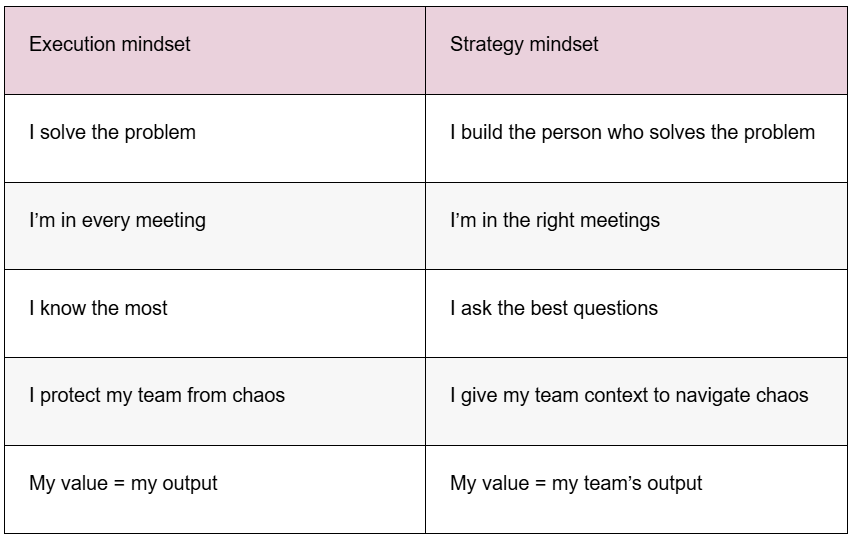
When I looked at this with my team this morning and when I’ve discussed this previously with leaders, the reaction is often the same: they recognize themselves immediately. Not in the strategy column, but primarily in the execution column.
Also I want to be clear that execution is critical at every level. But it’s important that we explicitly choose what to execute on, and make it a choice rather than a default.
So why is the shift so hard? Three real reasons.
1. Identity
“If I’m not the expert in the room, who am I?” Many senior leaders have never separated their self-worth from their individual output. This often extends beyond the workplace and is a deeper rooted fear pervasive in personal situations too.
2. Trust
“My team isn’t ready.” Sometimes that’s true (and if that’s the case, there’s a performance management opportunity). But more often it’s a story we tell ourselves to stay in control and to avoid the vulnerability of finding out what happens when we let go. We need to remember that we hire smart people to do hard things, and we need to let them.
3. Safety
“If something goes wrong and I wasn’t hands-on, I’ll get blamed.” This one is real, especially in organizations where accountability is punitive but it’s still a false story we tell ourselves. Leaders who stay in execution mode to manage their own risk often create the underperforming teams that eventually get them in trouble because they try to do six people’s worth of work instead of supporting six people to thrive.
Three things you can do this week.
One: identify your bottleneck moments. For one week, every time someone comes to you for an answer, ask yourself: could I have built a system, context, or capability so this didn’t need to come to me? Just notice. Don’t fix yet.
Two: run the “what would need to be true” test. When you’re about to dive into execution, pause and ask: what would need to be true for someone on my team to handle this instead? Then work backward to build that.
Three: shift one recurring meeting. Pick one where you’re doing most of the talking. Redesign it so your team is presenting, deciding, or leading. Your job in that meeting becomes questions only.
The hardest part of this shift isn’t the tactics. It’s sitting with the discomfort of feeling less useful in the short term so your team becomes more capable in the long term, and of making the space for strategic tasks that don’t immediately earn you a gold star.
Before you close this: write down one decision your team should be making that currently requires your approval.
Then go act on it.
What percentage is your split right now – and what’s keeping it there? I’d love to hear.